What a County Place Name Can—and Cannot—Tell You
A county place name can hint at landscape and language. Learn how to examine its spelling, setting and records without mistaking a clue for a full history.
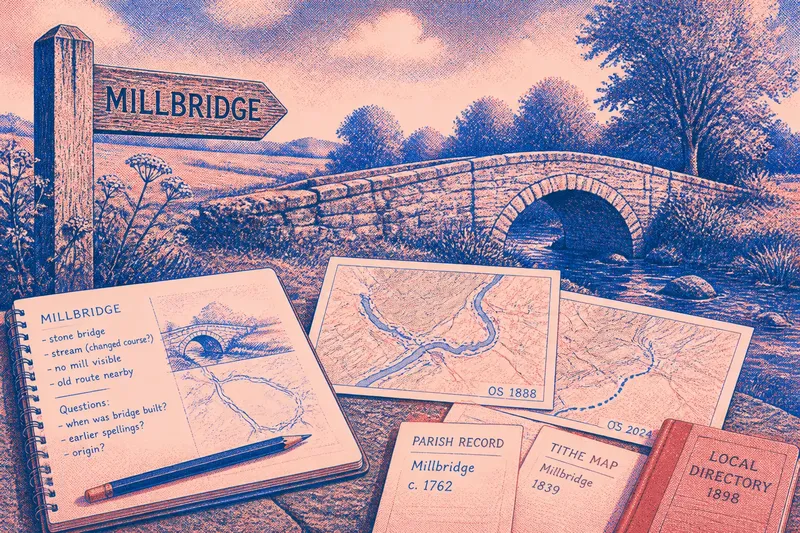
A county place name can point towards a stream, slope or older language, but it cannot explain its own history. A sign marked Millbridge may invite questions about a crossing or mill; the name alone does not tell you when either feature existed or who chose the wording.
Treat a name as a thread to follow, not a complete account. Its spelling, the ground around it and the records that preserve earlier forms each offer a different kind of clue.
Words and spellings
Some place names contain elements that resemble words for water, hills, woods, crossings or settlements. A first element may once have described a feature or referred to a person; an ending may suggest a kind of place. Such patterns can help you form a question, but they do not settle the answer.
Spellings and sounds change. A later form may have been altered to resemble a familiar word, while a current pronunciation may conceal older sounds. Names that look alike may have different origins, and an apparent meaning cannot, by itself, identify a name’s date or the people who gave it.
Write down the exact form you see and mark any proposed meaning as tentative. If you cannot connect it to earlier spellings or a reliable place-name reference, keep it as a possibility rather than a fact.
Names on the ground
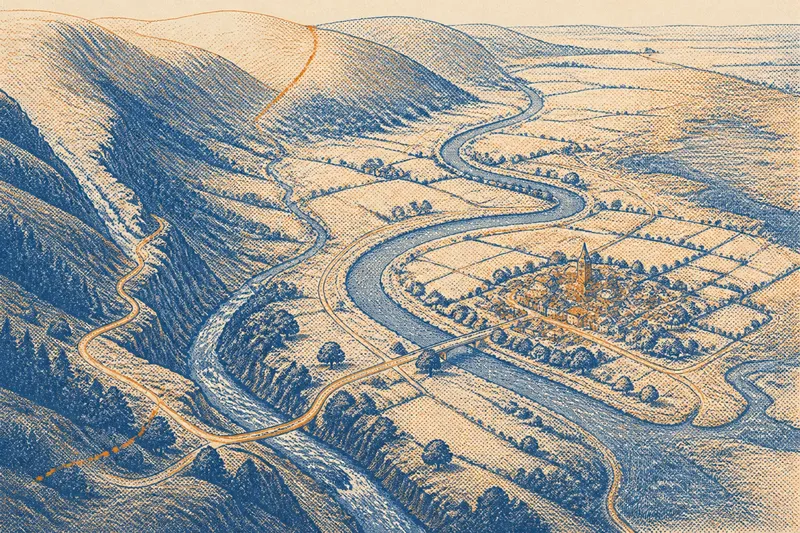
A suggested meaning becomes more interesting when the landscape offers a plausible counterpart. A name that appears to refer to a ford might prompt you to look for a crossing or an old route. But the landscape is not a fixed record: streams can be diverted, woodland cleared, and wet ground drained or built over.
Nor does a matching feature prove that it gave the place its name. A bridge near a place called Millbridge may be relevant, but it could be newer than the name, or the name could have another explanation. Record what you can see separately from what you infer.
Imagine you find “Millbridge” on a county map beside a stream. You check a public footpath and see a stone bridge, but no mill; then you compare an older map and find that the stream once followed a different course. The bridge is an observable clue, while the absent mill and changed watercourse leave the origin unresolved. Your notes now distinguish visible evidence from unanswered questions.
Records and their limits
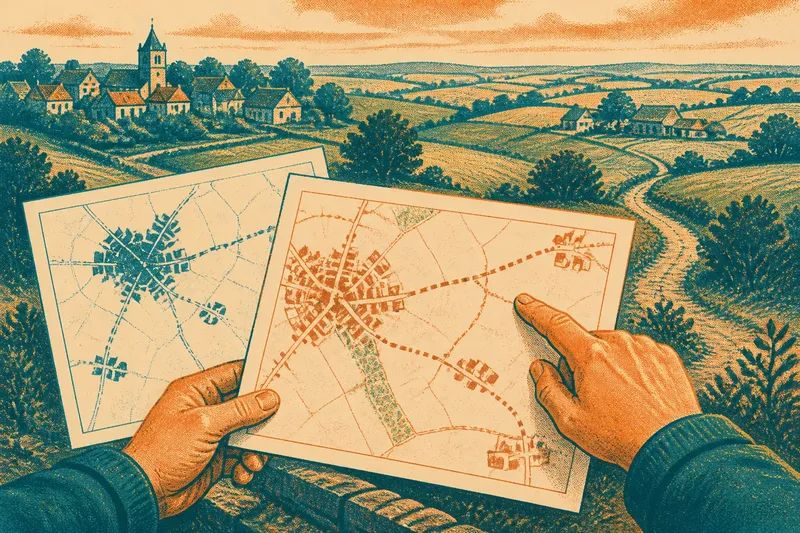
Older maps, parish records, estate papers and local directories may preserve spellings that differ from the current name. Compare the forms with their dates and locations. A sequence can show how a spelling developed, though the earliest form you find is not necessarily the first form ever used.
Pay attention to how each source was made. A clerk might write a name as it sounded; a map might repeat an earlier map rather than provide independent evidence. A document can establish that a particular spelling appeared in that source. It does not automatically explain the name’s first use.
For a local account, note the source beside each form and state what it records. County record offices, local archives and specialist place-name resources can help; their value depends on the material they preserve and the question you are asking.
Questions about names?
Can a place name identify an old landscape feature?
It can suggest one, especially if the name’s elements and local setting point in the same direction. The name alone cannot show that the feature remains or that the proposed meaning is correct.
Does an old spelling reveal the original meaning?
An earlier spelling may clarify how a name changed, but the oldest form you locate may not be its first form. Consider where it appears and whether other records support the same interpretation.
Why do nearby places have similar names?
They may share a language pattern, refer to related features or reflect a local naming custom. Similarity is a reason to compare their forms and settings, not proof of a shared origin.
Where can I check a proposed meaning?
Consult a specialist place-name reference alongside dated local records and maps. If the sources differ, describe the competing explanations and make clear what remains uncertain.
Choose a useful next step
The right next step depends on the clue you have. Use this short check to decide what to do with a name:
- Exact spelling: If the map and sign give the same form, record that form; if they differ, note both and check whether one is a local variant.
- Possible word element: If a reliable reference supports the element, record it as a candidate meaning; if not, leave the interpretation open.
- Visible feature: If a plausible stream, ridge or crossing is present, note its location; if it is absent, check for altered land or a changed route before rejecting the idea.
- Earlier form: If a dated record gives an older spelling, add its date and source; if it lacks either, do not treat it as a secure point in a name’s history.
- Repeated record: If two sources appear to document the form independently, compare their wording; if one copies the other, count them as a single line of evidence.
- Conflicting explanations: If sources support different readings, present both with their evidence; if one rests only on resemblance, describe it as a suggestion rather than a conclusion.
These decisions help match the strength of a claim to the evidence available. A name may preserve a trace of language or direct attention to a landscape feature, while leaving the full story beyond reach.
When you write about a county place name, give readers the spelling you examined, the records or landscape clues you used, and the point where interpretation begins. That small distinction lets someone else follow your reasoning—and check what new evidence might change it.